Wednesday, March 21, 2007

American MI5?

The Seventh Circuit Court of Appeals' Judge Richard Posner addresses the question of the lack of adequate domestic intelligence in the United States:

The FBI came under heavy criticism last week when it was reported that the agency had failed properly to supervise the issuance of national security letters, a form of administrative subpoena used in terrorist investigations. The bureau, it turns out, was unable even to determine how many such subpoenas it has issued.

Just weeks earlier, it was discovered that the FBI had been misreporting the statistics that it uses to track its intelligence activities. The bureau attributed that lapse to its continued struggle -- five and a half years after the 9/11 attacks -- to master modern information technology. The FBI also inflates its counterterrorist statistics by defining terrorism to include the acts of obnoxious but minor political criminals, such as white supremacists, animal-rights extremists and makers of idle (but frightening) phone threats.

Is it the case that the FBI is "incapable of effective counterterrorism," as an editorial in this newspaper wondered? Does the country need "to debate again whether domestic antiterror functions should be taken from the FBI and given to a new agency modeled after Britain's MI5"?

The answer to both questions is yes.

Quite a scathing pronouncement indeed. Fans of James Bond books and movies may be delighted at the prospect of having an MI5-styled domestic intelligence agency here in the United States, but civil libertarians are apprehensive. Judge Posner notes:

Civil libertarians worry about abuses of domestic intelligence. But an agency that had no powers of arrest or prosecution, and that conceived its primary role to be to prevent the alienation of Americans who have religious or family ties to nations that harbor terrorists, rather than to run up arrest statistics, would be less likely than the FBI to engage in the promiscuous issuance of administrative subpoenas.

How would an agency that had "no powers of arrest or prosecution" do its work? This can be quite befuddling, particularly if one views counterterrorism as nothing more than routine law enforcement. This is an understandable attitude, but only because the United States has never had a real domestic intelligence unit. In the popular media, the FBI or the CIA spies on citizens within the United States itself; but the CIA is not empowered to conduct domestic intelligence gathering, and the FBI's abuses are (supposedly) checked by the Bill of Rights, particularly the Fourth (addressing searches and seizures, including nontraditional searches and seizures such as wiretapping), the Fifth (addressing self-incrimination), and the Sixth (addressing right to counsel) Amendments.

The idea of an analog to MI5 has been around for a while, particularly after 9/11, when it was apparent that FBI agents did not act on tips from Arizona regarding some of the 19 hijackers taking flying lessons but never moving on to lessons on landing planes. And yet the FBI seemed mostly to have played by the book; indeed, its extra zeal now, particularly in taking advantage of the Patriot Act, seems like an overcompensation.

The remaining worry, then, is whether or not a domestic intelligence agency with no arresting or prosecuting powers would be at all effective. Further, to whom would it report? The Secretary of the Interior? The Secretary of State? And should it be placed under the Department of Homeland Security? Should it be placed under the Director of National Intelligence? How independent should it be from the FBI? What about turf wars between the FBI and a Domestic Intelligence Agency?

My gut instinct is that Judge Posner is right. He has articulated a great rationale for having a DIA. How that would be implemented, in the current political atmosphere, is another story.

Sunday, March 18, 2007

Wit of Mandamus III

On Friday, March 16, 2007, at 7:30pm in the Student Lounge at Loyola Law School, the third incarnation of a renewed tradition took place: Wit of Mandamus III. Law Law Stud proudly reported from Wit of Mandamus II, and continues to bring you reportage from the leading edge of LLS social life.


Article I

The show began with one of the student founders of the show, Cameron Fredman, jazzing along on the piano with the House Band, bringing out the Master of Ceremonies, Lenny "Ham Sandwich" Sansanowicz, another of the student founders of the show.

Abstract (part 1 of 3)

Abstract (part 2 of 3)

Abstract (part 3 of 3)

After Lenny's introduction, Zack Domb kicked off the musical performances with an original piece, "Melanie":

"Melanie" (part 1 of 3)

"Melanie" (part 2 of 3)

"Melanie" (part 3 of 3)

Taking the show in a slightly different direction, Mike Hanna wowed the audience with amazing beatbox skills. (Video clips courtesy of youngotti888.)

Mike Hanna (part 1 of 2)

Mike Hanna (part 2 of 2)

Next up, Carley Mak brought her friends back to a choreographed swing dance routine based on "Sister Kate", and to a jam with the House Band.

"Sister Kate"

Swing Dancin' with the House Band

Following up was the Stud himself. Lenny gave a most moving introduction as he passed the Wit of Mandmaus torch. Curiously, there are currently no video clips of this act.

Scott Wilson, President of the Day Student Bar Association, performed Frederic Chopin's "Valtz in A#, Op. 42".

Scott Wilson Playing Chopin (part 1 of 2)

Scott Wilson Playing Chopin (part 2 of 2)

Teresa Straley, an LLS alumn, was next with her original work, "Once Upon a Time", accompanied by Professor Jay Dougherty.

Stephen Cawelti, another LLS alumn, then joined them to sing the Beatles' "I Saw Her Standing There".

Next, Professor Allan Ides and 3L Alex Diaz joined them to play "Ruby Tuesday".

Closing out the first half of the show, Craig Kirkwood sang as he and the House Band brought the audience George Gershwin's "Summertime" from Porgy and Bess.


Article II

Ushering in the second half, albeit without an intermission, playwright-scholar Jose "Oldman" Garcia, and a quickly assembled cast, brought us "In re Tramp", a hilarious series of law school jokes regarding a claim brought against one Miss Hilton for adverse possession of a love interest.

Due to the sudden shift in schedule, the Stud didn't quite catch Dennis "Funhouse" Martin in "Stolen Moments".

Shifting back again to law-related humor, Professor John Nockleby and the Noklebettes, with the House Band in support, sang their hearts out in "All I Care About is (Torts)". The Stud regained his equanimity just in time to catch the last part on video.

Next up was singer-songwriter David Jonelis, who had already made his mark at the 2006 PILF Auction. For Wit of Mandamus III, David played an original work, "Reflections".

Zack Domb officially introduced the audience to Bill Shafton as they performed Zack's new original piece, "Angie". (By request, a clip of "Angie" will not be posted.)

Then, Bill was on his own as he played an amazing rendition of "Redemption Song", first softly with finger picking style, then strumming with an energetic pick.

"Redemption Song" (part 1 of 2 - finger picking)

"Redmption Song" (part 2 of 2)

Not to be outdone, Director Jonathan Stout displayed his talent in "Dark Eyes", backed up by Zack Domb on the guitar and John Given on the bass. Jonathan is a regular Django Reinhardt!

As the show neared its end, Puya Partow delighted the audience, dancing and twirling to "Billie Jean".

Finally, to close out the night, the Professors returned to the stage for a medley, including "Midnight Hour", "We Gotta Get Outta This Place", and "Gimme Some Lovin'". Preparing to wrap things up, the Stud did not obtain video of the entire medley (only "Midnight Hour"), but rest assured, it was a thing of beauty!


And thus the night came to an end. The Stud thanks all the performers for putting on such a terrific show; the audience, for making the performance worth putting on; all those who helped with last minute changes (you know who you are); and Giancarlo, for manning the ticket table.

Finally, if you were not able to attend or perform this year, the tradition will keep going. Get on the boat early, and we'll see you next year!

Acknowledgments

Credits

  • Producer: Bruce Chang
  • Director: Jonathan Stout
  • House Band: Zack Domb (guitar), John Given (bass), Cameron Fredman (piano), Jonathan Stout (drums)
  • Master of Ceremonies: Lenny Sansanowicz
  • Spotlight: Tim Oppelt
  • Publicity: Mike Hanna

Special Thanks

  • Marti Reynolds, for showing us the ropes
  • Ernesto Lozano, for coming through
  • Professor John Nockleby, for inspiring us at 8am
  • Lenny Sansanowicz and Cameron Fredman, for starting a tradition
  • Tim Oppelt and Jenn Rich, for continuing the tradition
     
    - and -
     
  • The Staff of Loyola Law School


(All videos except for Mike Hanna's beatbox routine were taken with a Canon Powershot S70, set at a resolution of 640x480.)

Monday, February 26, 2007

Barristers Ball 2007

Barrister's Ball came a little earlier this year, but that worked well for the hundreds of fun-starved law students and their friends and significant others that descended on the Music Box @ Fonda in Hollywood on the night of Saturday 24 February 2007. As Law Law Stud sauntered toward the front door, a bright yellow bus pulled up with dozens of hooting partygoers.

This year, there was no special rate for couples, as the Student Bar Association tried to incentivize stags to go and party anyway, despite the characterization of the party as "Law School Prom". Whatever the rationale, the turnout was fantastic. Law Law Stud had a nice, sedate dinner with friends, and before much time had passed after the arrival at the Music Box, the night frittered into a frenzy of meet-and-greets. Law Law Stud caught up with friends from all years of law school. Of the 2Ls, the former Section 3 made the best showing.

First Amendment Symposium

This weekend past, a First Amendment Symposium was held at Loyola Law School in honor of esteemed alumnus Steven Shiffrin. It was attended by eminent constitutional law scholars, including Erwin Chemerinsky, Kurt Lash, and Eugene Volokh. The topic was commercial speech, particularly in the context of Kasky v. Nike, Inc., 27 Ca. 4th 939 (2002). I've broken down just a hint of the arguments that each of the distinguished speakers made.

First Amendment Theory

Martin Redish
The arguments for reduced protection for commercial speech tend to fall into three categories:

  1. Rationalist: This group claims to be neutralist, and rationalist policies tend to be suspiciously underinclusive, and tend to exempt media corporations because their very product is speech, but restrict other corporations because they advocate non-speech products.
  2. Intuitionist: Dan Farber was the main advocate of this group; it is both anti-intellectual and intellectually arrogant. It cannot be responded to, and there is no way to decide whose intuition is correct.
  3. Ideological: This side tends to want to suppress speech because of a paternalistic notion that commercial speech makes people buy things they don't need. There is no trust of individual choice.

Robert Post
We cannot begin under the premise that all speech is protected, and that any derogation is a violation. What is actually covered is much less than the universe of all speech. For example, contractual terms and confidentiality agreements and relationships are not covered. If all speech were covered/protected, then daily life becomes an unceasing constitutional question. In fact, viewpoint discrimination happens all the time, such as when grants are distributed, when public school students are corrected, and so on.

We protect only that speech which lays a part in democratic self-governance--that speech which contributes to political diversity. Political statements are not compelled, but commercial statements may be compelled, such as disclosures and disclaimers. As to, for example, Consumer Reports criticisms of commercial products, it is not whether we should differentiate between political and commercial speech, but rather, where the boundaries lie.

Steven Shiffrin
What's wrong with intuitionism? That's how the common law is developed, after all. Some regulation is okay, such as the FTC and the SEC--it's all for the protection of the consumer.

By the way, self-government is a fiction, an illusion of participation. Also, commercial speech, by making materialists of us, undermines the development of participation and of an active citizenry.

James Weinstein
It is incorrect to call all who disagree "ideologically hostile to the premises of capitalism." E.g., Rehnquist, O'Connor, Posner, and others, are unarguably capitalists, and yet they would disagree with Prof. Redish.


First Amendment Principles in Practice

David Vladeck
Early commercial speech cases involved anti-competitive regulations (about 50%) or anti-vice regulation (about 50%). Nike v. Kasky was the first one to address expressive commercial speech. Contra Prof. Shiffrin, the FTC/SEC/FDA are not the pit bulls he thinks they are. In fact, under strict scrutiny, the regulatory agencies have retreated. E.g., dietary supplements have been permitted to make unverifiable claims (so long as they are not verifiably false). Interestingly, pharmaceutical manufacturers have begun lobbying Congress to expand the department which pre-screens their commercials.

Bruce Johnson
Nike v. Kasky has not been revisited in any other case in the U.S. Supreme Court. They key issue in Nike v. Kasky turned on whether or not Nike's claims about the manufacturing, in response to Consumer Reports, constituted commercial speech. One reason for the lack of a follow-up to Nike was because of Proposition 64, which limited the free rein that California had once given to anyone with a bar license to sue any corporation, even without a showing of damages.

Judge Robert Lasnick
There is a ring of truth to claims of judges' power to decide what is educational, what is obscene, etc. Much is context-specific. Bill Gates speaking as Chairman of Microsoft is heard with some skepticism, but is given a wider berth as Director of the Bill and Melinda Gates Foundation. In essence, it's a lot more pragmatic than some of the loftier principles discussed by the law professors.

Note: Reckless disregard is a lower standard than intent, and in the era of easily saved e-mails, much more evidence can be swept into scope.


Philosophical Underpinnings of the First Amendment

Seana Shiffrin
Defense of autonomy: voluntary associations should be able to exclude for any reason--including invidious ones--or for no reason at all. This forms the basis for private regulation, as individuals govern their speech differently for different fora. We already regulate corporations in economic contexts.

Glickman and United Foods both involve compelled advertising. Such advertising was ruled constitutional in Glickman because the advertising was germane to the purpose for which the association was formed. In United Foods, the advertising was struck down because it was not germane to the associational purpose.

We should not encourage markets to see themselves as amoral. In the commercial context, there is reason to differentiate between that speech which is purely self-interested, and that which carries a moral and/or political message. Restrictions on commercial speech should be much lighter for non-self-interested speech.

C. Edwin Baker
Three reasons commercial speech should be completely denied First Amendment protection (despite first having approached this from a libertarian perspective):

  1. The capitalist economy really leaves economic actors no choice but to act in the most efficient behavior possible, and thus to engage only in speech that leads to profit.
  2. A business enterprise is only a person in the legal, fictitious sense, not a flesh-and-blood person, so corporate behavior which is harmful to society should be proscribable.
  3. There may be paternalism, but it doesn't stop a message, except where the only persons, natural or not, that are willing to get the message are the sellers--in which case, is it really so bad? Besides, the very notion of a democracy is paternalistic, and empowers further paternalism.

Exercises of power may be appropriate in some contexts. Government exercises of power are legitimate anyway; market exercises of power are not subject to democratic processes, so are illegitimate. [Martin Redish characterizes this view as Jacksonian in its distrust of money.--LLS]

Charles Fried
I couldn't disagree more with Ed Baker. The most important liberty is liberty of the mind. Since we are embodied minds, it's an easy step to liberty of the body, as recognized in Lawrence v. Texas. An embodied mind necessarily leads to expression of the mind through emobided words--speech. Baker proposes to treat all cooperatvie work as radically different than individual exertions. Is, then, a performance by the L.A. Philharmonic, then, to be treated radically different from a solo performance? What if I pay other musicians to play with me as a string quartet? Baker's proposal that any cooperation which is compensated is somehow unfree, diametrically opposed to pure, individual existence, simply does not stand up to reality.

Cooperation, like a symphony orchestra, or a string quartet, or a couple making love, is a group of people organized for a common effort. We should not reify such organizations. We should not treat speech differently because a corporation does it rather than an individual.

Rebecca Tushnet
There is no problem with assigning different meanings to words per se; the problem arises when the speaker's definition is not disclosed--and even more so when the listener has a different definition. We often solve this problem by designating an entity to decide in conflicts of definition; those proposing more protection for commercial speech propose a different decider--the jury. But choosing a different deciding agent does not resolve the underlying problem--people have different definitions for the same words.


Concluding Reflections

Tamara Piety
The field of regulating commercial speech based on truth or falsity has become, like the debate about obscenity and fighting words, an empty set.

Eugene Volokh
Some broader trends in First Amendment jurisprudence have arisen over the years. The basic theory is that there may be some speech that is less or not protected.

Steven Shiffrin's reaction against materialism runs some risks. First, materialism is not necessarily bad; after all, sometimes we show our love for our families through giving materialist goods. Second, societies that have retreated away from consumerism have often come to bad ends, including utopians who run totalitarian states. In fact, the equal rights movement may have been well-driven by the desire to have equal access to riches--and a religious focus may not have given rise to such a movement, because in religion, only the afterlife mattered, and all were equal before god. [But what about the British abolitionist movement?--LLS]

Be skeptical about theories, and how we apply them, e.g., in deciding which speech should be protected. Also, most people underestimate the amount of speech that is incontrovertibly protected or incontrovertibly unprotected.

C. Edwin Baker
Most speech that is recognized as valuable is speech that nobody thinks to regulate. [This seems to place the cart before the horse.--LLS]

We should not personalize the corporate speaker.

We need an image of the First Amendment. The "marketplace of ideas" does not work. The dissenter, which Shiffrin proposed, may be more apt.

We allow all kinds of viewpoint discrimination anyway, but no one has made an argument against restricting commercial speech other than alleging paternalism. [But what about the corporate right of reply?--LLS]

What about corporate political speech? If we can limit press political speech through equal time requirements because of their power and reach, shouldn't we also limit corporate commercial speech for the same reason?

Wednesday, February 07, 2007

Is Law School a Waste of Time?

The second half of second year is well under way now, and the Stud is feeling a little burnt out, to the degree of actually missing a bar review. At times like this, one can't help but wonder if law school is a waste of time. Here's a snippet:

The Carnegie Foundation is correct in observing that law schools are weak at teaching prospective lawyers the kinds of client-representation skills that Stracher’s adversary had mastered so well on his own. The fact, however, that it is quite possible for people like him to learn those skills somewhere other than in a law school ought to cause us to wonder if a formal educational setting is really the best place for lawyers to develop the representational skills they need. That competent paralegal may have been so good because he observed lawyers in action. If he had spent three years in law school, he probably would have known less about how to advocate for his clients.

We at Loyola Law School are fortunate in that LLS does not shy from employing adjunct professors for practical as well as theoretical coursework. In fact, Loyola is well-known for the continuing practical legal education it provides for Los Angeles-area attorneys. My fellow Legal Lions, take heart! And since you're in it already, make the best of it!

Sunday, December 17, 2006

The LLS 2006 Fall Evidence Discussion

Pursuant to a request, I am starting a discussion for Evidence. Unlike the discussion for Con Law 2, I am starting this before my outline is completed. There are enough readers that know enough about different parts of the subject to help each other out. Further, consider this a gathering place, a bulletin board, for students to trade information on helpful suggestions. Because Loyola Law School has the most helpful students!

Update: (2006.12.18.01:50 PST) Goldman students: Here are notes from the review he had on Monday 4 December:

Agency theory
If the only evidence you have to support a theory of agency is the fact that the agent declared himself an agent, that is not admissible in any jurisdiction to prove its point; however, in federal court, if it has been admitted for other purposes, it is admissible as partial proof of agency

Present recollection refreshed vs. past recollection recorded
When can something be read into evidence, and when can it not? You can read into the record a past recollection recorded; if it is a present recollection refreshed, the refreshing document may not be read into the record on direct examination. A present recollection refreshed does not qualify as a past recollection recorded because one of the elements of a past recollection recorded is missing: that the person does not remember.

State of mind
California requires, for past state of mind, that the declarant is unavailable, and that there is high degree of trustworthiness (that the statement was what the declarant believed).

Corrections
In the chart on state of mind, there is a mistake. Where it talks about “future conduct by someone other than declarant”, change CEC 1251(b) to CEC 1250(b). Actually, scratch it out. It should be “yes, according to case law”.

Authentication
You always have to authenticate. For example, a business record needs to be authenticated before you can even object to it as hearsay, much less claim an exception for business records. If a witness does not authenticate a writing as hers, you can still authenticate in some other way, for example by using a handwriting expert.

Prior convictions
California doesn’t follow a strict collateral rule like the federal courts. California pretty much only goes by CEC 352, so it’s a case-by-case determination.

Attorney-client privilege
Gossip is not included.

Prior inconsistent statements
California seems to have the most flexible rules, allowing a court to keep a witness on call after examination. This may consume a lot of time, but California is more concerned with fairness.

Statements identifying a person
If a witness has identified a person, but subsequently claims not to remember, is that a consistency issue? Is there a problem with the prior identification? There is no problem; in fact, if the identification has been made, there’s no point to try to establish the identification again. By the way, there is no requirement that the prior identification have been made under oath.

Prior consistent statements
In federal rules and common law, there is only one trigger—an allegation of “recent fabrication”; in California, there are two triggers—an allegation of “recent fabrication” and prior inconsistent statement.

Best evidence rule
If a doctor looks at an X-ray and also determines from other methods that his patient had a broken leg, is his testimony that the patient had a broken leg admissible? It may be. In order to exclude this, we’d have to isolate his diagnosis to the X-ray alone, triggering the best evidence rule.

Admissions
Do they have to be to the other party? No, they can be to anybody.

Tuesday, December 12, 2006

The LLS 2006 Con Law 2 Discussion

It's that time of the semester, and Con Law 2 draws upon us. It seems like a simple subject at first, but surely many of you have realized that it's not quite that simple. I realize it's a bit late in the game, but I have a special deal. I'm the type that doesn't feel secure in his knowledge unless I'm being challenged with questions. They don't have to be complex, but I invite you to submit your questions, and I will be answering them throughout the night.

Please post your questions in the comments. I will answer here, and you are all welcome to answer each other if my answers don't quite cut it. Have at it!

Sunday, December 10, 2006

Hearsay Exception

For all my peeps in Evidence, learn this, and learn it well!

This has been a public service announcement.

Friday, November 10, 2006

Bar Review - Hollywood Canteen

The Stud is no stranger to Hollywood Canteen; in fact, it is a fun place. The powers that be apparently agree, and the last Bar Review of the semester was held there.

Turf Club - Part VIII

The last Turf Club of the semester came with a pleasant surprise: There were In-N-Out Burger Carts on the basketball courts! There were rumored to be only 300 burgers available; whatever the actual number, most of those who got in line (and it was a very long line) managed to get burgers.

We should do this again some time.

[]

Monday, November 06, 2006

Sentenced to Hang

Saddam Hussein has been sentenced to hang. Unsurprisingly, his Sunni cosectarians were none too happy about that, and the Shiites rejoiced. Saddam's sentence is automatically appealed, as it is a death sentence. (On a separate note, one of the codefendants, who received a sentence of life imprisonment, has also had his sentence automatically appealed.) Europeans will surely not like this; the issue of capital punishment has been resolved, for the foreseeable future, in the negative. However, for much of the world, this seems to be appropriate punishment. In fact, by Iraqi standards, the transparency of the trial is unprecedented.

Some argue that the sentence should be void because the entire trial was a kangaroo court, or at the very least lacked jurisdiction. However, the symbolism of the proceedings, and their educational value, may in a sense be more important here. Had the trial taken place in the United States, there would be much made of due process. American law also tends to differentiate between moral culpabilities involved in crimes by differentiating between the charges. Hence, the differences between involuntary vehicular manslaughter and first degree murder. The different charges open up different levels of punishment. In the Saddam case, the primary issues seem to be causation and punishment. That is, did Saddam effectuate the crimes of which he has been accused, and how harsh should the punishment be?

There is no doubt a long litany of accusations against Saddam, for offenses perpetrated by his regime. While it seems likely that he authorized the carrying out of these crimes, it does not seem beyond reason that one or two incidents were not explicitly or implicitly authorized by him, and that his culpability may only be to the extent to which he overlooked them. For such incidents, he is still accountable, but it is arguable that the death penalty is not a proportionate response.

Of course, the final arbiters of proportionality must be Iraqi. It would seem unrealistic that a majority, much less a supermajority, of Iraqis would approve of the death penalty. I doubt that any debate about it within Iraq would be all that controversial; indeed, the soul-searching seems mostly to be among intellectuals of the West. Many of a liberal bent reject both crimes against humanity, as well as the death penalty, for similar reasons (many of which find their roots in liberal Christianity, ironically). In the case of Saddam, they may be forced to compromise one or the other value.

Or, of course, they can try to sidestep the issue by hanging on to the claim that the entire war was illegal to begin with. That's another discussion altogether, and raises legitimate points of controversy. But it does not resolve the question of, "Now that we're here, what do we do?"

Sunday, October 22, 2006

Inter-APALSA Mixer

APALSA is expanding! On Friday 20 October 2006, the Loyola Law School APALSA got together with similar law student associations from other schools, including at least Southwestern Law School and UCLA for a mixer event at Ma'Kai in Santa Monica.

Accountability

On Monday, the second-year day students began to register for classes for the next semester. First year students and second-year evening students were auto-registered for their classes, and more advanced students got priority because they were closer to graduation, so they needed to fulfill their requirements.

The time was 7am. Hundreds of sleep-deprived souls logged onto the registration website. We entered our passwords, and clicked on the "Registration" tab. We were told we were ineligible. Puzzled, we thought that perhaps the clock on the server was running behind. Every minute, we refreshed.

By 7:10, students were calling each other and IM-ing each other. On AIM, a chatroom was created, and students went there to vent. The tension was palpable. People were calling the Registrar's office and the Dean's office. Nobody was picking up.

At one point, one of the students relayed a message to the chatroom from one of his friends, who had figured out a way to get the registration program to work. The workaround was to paste a javascript command into the address bar of the browser. Apparently, although the application did not give us the link to the add/drop classes function, it did not prevent us from seeing the javascript function for modifying classes in the current semester. The student who figured out the workaround basically took a look at the javascript command for modifying classes in the current semester, and changed two parameters, one of which simply stated the year and the semester. It was a brilliantly simple workaround.

As the news spread throughout the chatroom, people tested the workaround and confirmed their success. The excitement raced through the room, and students began IM-ing, e-mailing, and calling their friends to let them know about the workaround. It was a simple matter to dig up old e-mail lists that addressed entire sections from first year, and use that to spread the knowledge. People were elated.

As the day went on, however, the Registrar finally got wind of what was going on, and clamped down. Registration was rescheduled for Tuesday, again at 7am. The e-mail went out at 9am. I quickly jotted off a note to Dean Burcham, expressing my disappointment with the performance from the IT Department and the Registrar's Office. I wrote the following:

Dean Burcham,

I was very disappointed by the events of this morning. Many students cut back on their hours of sleep just to wake up in time to register for classes. For over half an hour, we worried about what to do. One student found a solution that worked. The solution was fairly obvious, and reminded me of a workaround that was used in June for about a month by those of us who were trying to figure out what our grades were so we could update our resumes. I.e., the solution required only some insight, but no genius.

Those of us who tried the solution then tried to help as many other students as we could. There was a great deal of satisfaction for those of us who were able to help others. This, I think, is truly the spirit of what we're trying to learn: Figure out what the rules are, succeed by those efforts, and help one's fellows. It was truly the best of our nature.

But now, we are told, all our efforts are for naught, and we all have to curtail yet another night's sleep. All this, for something on which the IT Department completely dropped the ball.

This is not the first time ITD has come up short. Others include:

  • The wireless outage that lasted half of Spring 2006.
  • The inability of students to see their grades during June.
  • The breakdown of events-mail.

All three of these occurred during 2006. In the same calendar year, tuition has gone from about $30,000 to about $34,000. While tuition hikes are to be expected, and minor glitches in IT are not completely out of the ordinary, the combination of debilitating breakdowns in IT and the higher rates causes one to wonder whether or not the IT Department, as it currently stands, is worth the money we spend on them.

I am writing only as myself; but I think I'm probably not the only one disappointed and upset by this experience. I don't think it's an answer to say, "oops, we messed up." I don't think it speaks well of the university to say that students who had the insight to figure out a way to get something accomplished, and then help their fellows, should now effectively be punished for their intelligence and their compassion. It is unacceptable, and it is contrary to the spirit of Loyola Law School.

The Dean expressed his disappointment at the performance as well, but stood by the policy of making everyone get up again at 7am the next day to register for classes. I understood that just fine. In fact, as I went to the library to study, I ran into a classmate who had overslept, and was cutting class just to go to the library to register. When I told her that would be no registration at all that day, she was elated. And I wouldn't want to take that away from her.

Still, quite apart from the question of "fairness" was the question of accountability. I replied to the Dean thus:

Dean Burcham,

I doubt that the concern is with the fairness of resetting things for the benefit of those who did not have the work-around. Coming into the library, I spoke with one student who was on the verge of breaking down because her computer had broken down at home, and she thought she wasn't going to be able to get the classes she wanted. She skipped class to go directly to the computer lab; but once I told her what had happened, she was elated, and could go do her reading. In the same spirit with which those of us with the workaround tried to help others, we would not want to deny fairness to those who did not have the workaround.

What primarily concerns me at this point is more of an accountability question. This also relates to the matter of tuition. Speaking with a couple of other people who have computer backgrounds, we noted that the registration system, as currently implemented, is open not only to workarounds for human error, but also possibly to abuse. (This is only speculation; nobody I spoke to had enough energy after getting through registration to figure out how further to exploit the web system.) Again speaking for myself, I consider it beyond disappointing that there have been so many breakdowns with IT.

To put it plainly: What are we getting with the money we pay into IT?

Human error is understandable. But when tuition has gone up faster than inflation, much else remains at its excellent level of quality, but IT is noticeably impaired, particularly compared with the previous year, it is only reasonable to wonder what we're getting for our money.

Finally, around 4pm, the Registrar sent out another e-mail, stating that all registration activity that was logged between 7am and 1pm that day would be purged, implying that nothing was done to prevent the workaround for about 6 hours. Sure enough, when I logged on to the school intranet, the "Registration" tab was gone. But, as someone pointed out, the "View My Schedule" tab was still available. I clicked on that, and then the "View All Enrollments" link, and all the classes I had signed up for were still listed. I guess the "purge" wasn't going to happen.

When I checked again a couple of minutes later, however, the classes were gone. Still, the page was similar enough to the "Registration" tab that I decided to give the workaround another try. It worked. I quickly spread the news to a few people.

Finally, around 6:30pm, the Registrar and IT disabled the entire registration website.

The next day, at 7am, hundreds of students again gathered in front of their computers. Those for whom the site loaded in less than 30 seconds saw that they were still ineligible to register for classes. A mad fury of refreshing began.

The Stud made it through on the first refresh, and was able to sign up for classes. By 7:02am, the Stud was done.

But the debacle took its toll. Thousands of student-hours of sleep, and thousands of student-hours of reading, were wasted as students spent Monday morning trying to figure out if the Law School Gods were, in fact, crazy.

The Stud attended the Dean's Forum on Tuesday to speak about the total breakdown of communications, and (unfortunately) of courtsey (on the part of the Registrar). The Dean attempted no defense, and apologized profusely.

Tuesday has come and gone, and registration is complete. But for many students, it was a bitter experience. More than one student who found out about the workaround late on Monday did not get the classes they wanted on Tuesday, because the site took too long to load, and they could not get signed up for certain classes in time.

Saturday was the PILF Auction, which brought together faculty and students for an essentially charity event. But more needs to be said by the IT Department and the Registrar's Office before second-year students can really appreciate them again. An official mea culpa is needed.

Where is the accountability?

Monday, October 16, 2006

Turf Club - Part VII

The second Turf Club of the 2006-07 school year was much improved on the previous one. With two kegs, smaller cups, and fewer first years (who were mostly busy studying for recovering from midterms), there was much more of everything to go around. Moreover, this time the event was set up on the basketball court. While that meant no more high-flying stunts of the sort that took place after the previous Turf Club, at the same time there was much more room for people to move around and mingle.

In fact, a few members of the 2005-06 Section 2 had a mini-reunion.

By the way, congratulations to the 1Ls for finishing a grueling two weeks, during which midterms and memos came due. Don't let up the pace now!

[]

ILS Potluck

Coming a little bit later this year than last, on Sunday 8 October, the International Law Association (ILS) nonetheless did not forget the tradition of having a potluck at Professor Friedler's home in San Marino. Much food was brought, which apparently caused the ILS President, Vakhe Khodzhayan, to burst into song:

Yours truly also participated in the festivities.

Incidentally, Professor Friedler made a fantastic sangria, of which yours truly partook. Not saying there's a causation or anything.

[] []

Tuesday, September 26, 2006

Byrne Trial Advocacy Team

On Saturday 16 September, 43 ambitious law school students competed for the right to enter the finalist round of competition for a set on the 2006-2007 Byrne Trial Advocacy Team. It was a grueling competition; only 16 were selected to go to the final round. Of the two fine gentlemen here, both articulate speakers, one made it to the next round (the dapper young man in the full suit). Neither made the final roster.

Congratulations to the men and women who made it onto the team: Michael Abed, Malaika Clements, Danielle DeSmeth, Gavin Doyle, Terrence Jones, Hooman Kazemi, Anand Kumar, Prateek Lal, David Palmer, Gautam Sood, and Sara Yin. Sara represents 2005-2006's Section 2.

Best of luck to the team as they take on the nation's best throughout this year!

[] []

Monday, September 18, 2006

APALSA BBQ at Griffith Park

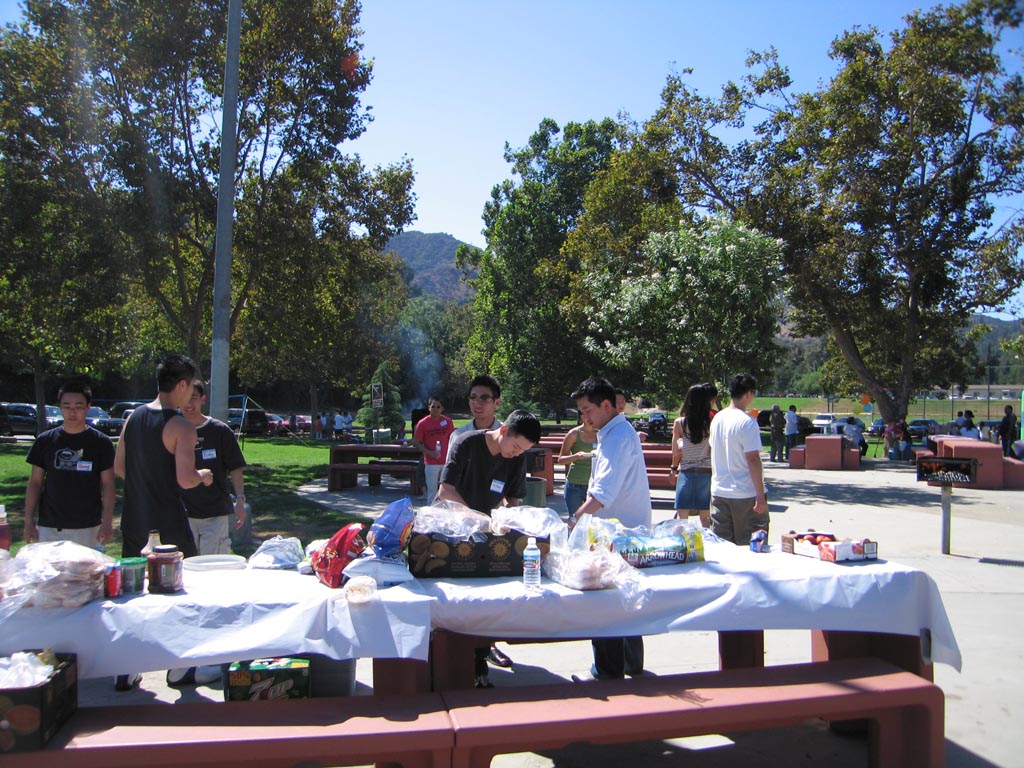
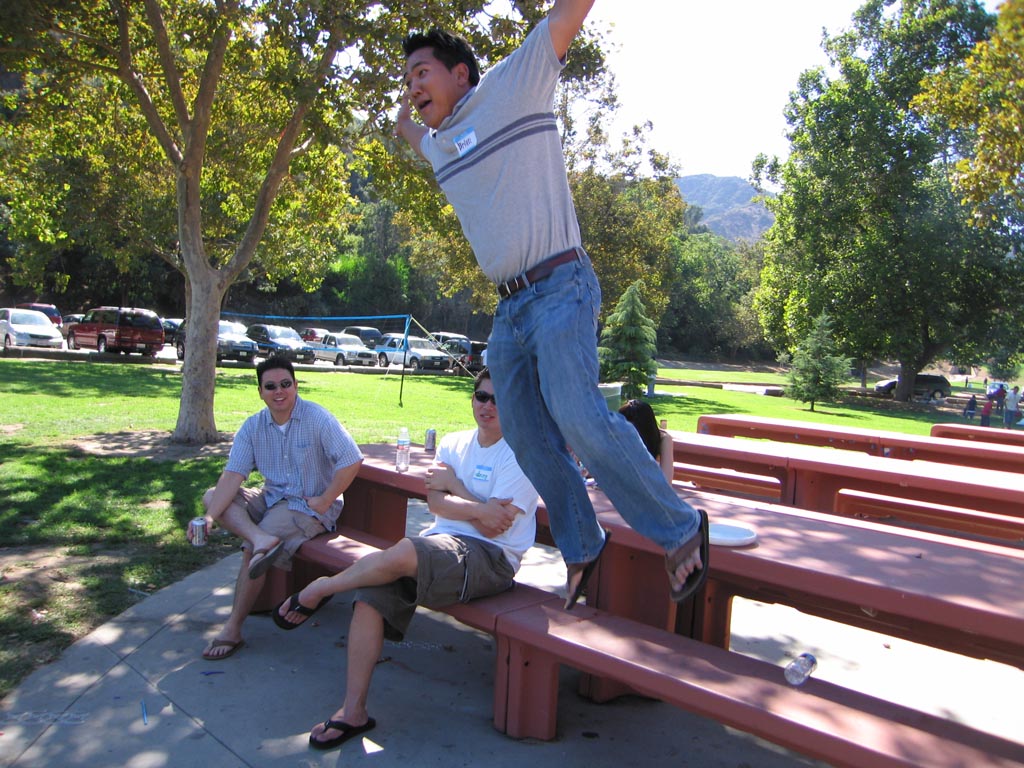
As the summer days wound down, the Asian Pacific American Law Student Association (APALSA) held its annual welcome BBQ at Griffith Park. Here are snapshots of some of the moments:

The spread:

Will Choi about to bite off more than he can chew!

Brian Jun is extremely happy about the amount of meat!

The Stud with his mentors, J-chizzle and Sam:

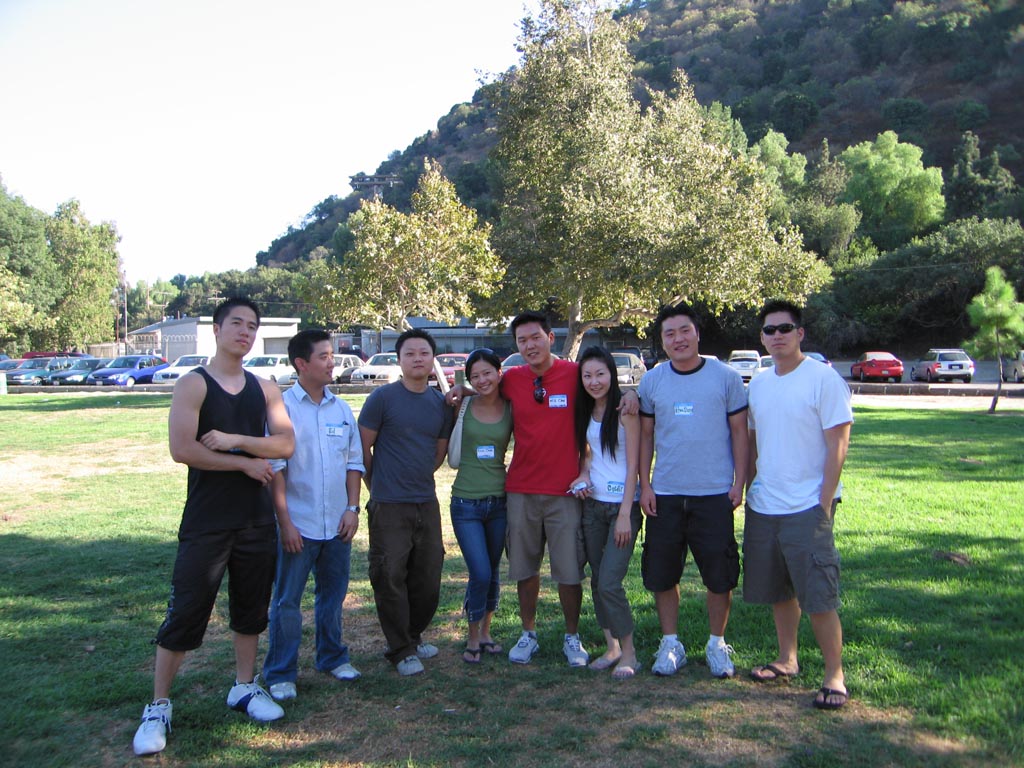
The APALSA Board: Charles Lin, Ed Yun, Pete Hong, Alice Chen, Will Choi, Cathy Kim, Hee Sung Yoon, and Danny Yoo.

APALSA has also organized a presence on Westlaw as a TWEN course. Add APALSA for more information on future events.

[] []

Friday, September 15, 2006

Turf Club - Part VI

Turf Club started back up this semester. Rumors are that there will be fewer of them this year.

For this first Turf Club of the school year, Westlaw came out as a sponsor, along with their nice big cups. The cups, unfortunately, had the effect of draining the keg of beer a lot quicker than the usual party cups that Turf Club usually uses.

In addition, the even was much better advertised, and quite a large number of students turned out in the waning days of summer.

Afterward, a few students decided to indulge in a pick up game of basketball.

[]

Saturday, August 26, 2006

Welcome Back at Hotel Fig

Each year, the Loyola Law School Student Bar Association arranges to have a Welcome Back party at nearby Figueroa Hotel at 939 South Figueroa Street, also better known as Hotel Fig. When I had gone last year, I knew only a few people, and met perhaps two second year students. This year, the turnout seemed bigger, and I definitely mingled with many more people.

Heck, one first year (who shall remain anonymous) even came up to me and asked if I remembered her from a birthday party I had attened last year. Fortunately, now that she's a student, I'll have less excuse to forget.

The walk over from school is a short one. The major cross-streets are Figueroa (of course) and Olympic (this is a view from the southwestern corner):

Hotel Fig looks small-ish at first, but the pool area, which is where the party was, is through this hallway:

At the last light of day, the party had yet to get going. Once things got swinging, though, the pool area was standing room only. Much fun was had.

It was great to see all the advanced students again. Welcome back, and a hearty welcome to all the first years who found time to join us at the party. This is only the beginning of a journey, and you'll find fellow travelers along the way that, with some luck, will be traveling with you far beyond law school.

Friday, August 25, 2006

ExTORTion

For those who are interested in a career in tax law or even personal injury law, the D.C. Circuit has ruled that non-physical personal injury (emotional distress, loss of reputation) compensation unrelated to lost wages and earnings is not "income" within the meaning of Amendment XVI, rendering § 104(a)(2) of the Internal Revenue Code unconstitutional. This would appear to be a win for the "little guy".

TaxProf Blog has more.

[] []